Case Study
The Results Hub
A feature that gives people the one thing their blood test results never came with. Context that actually makes sense for them.
Product Management Capstone·Camila Klein Rinaldi·neuefische·June 2026
01 — Why this project
A frustration shared by almost everyone I interviewed.
You go for a blood test. You wait. You get a PDF, or a push notification, or a print-out. And then you're alone with a table of numbers and reference ranges you didn't study for. Maybe your doctor calls. Often they don't. When they do, you get two minutes. You leave with the same vague reassurance: "everything looks fine." But fine compared to what? Fine for whom?
The health system was designed to route data through the system, not to make it legible to the person it belongs to. As a PM student at neuefische, I wanted to work on a problem that was real, systemic, and solvable from the product side.
The Trigger
After speaking with women in my network, a pattern emerged fast: they were all health-aware, all proactive — and all managing their results alone, with tools that weren't built for them.
The Opportunity
AI had made interpretation accessible. People were already using ChatGPT to make sense of their results. What was missing was a product that made it safe, personalised, and trustworthy.
02 — The Problem
Three compounding failures.
The baseline problem
Reference ranges are calibrated to population averages, typically a 30-year-old man. A 40-year-old vegan perimenopausal woman is being interpreted against a baseline that erases her.
The translation failure
Even when a doctor wants to bridge the gap, the system doesn't give them time. The result: silence after results, no follow-up, and a PDF expected to speak for itself.
The self-help gap
When the system fails, the ability to compensate depends on skills the system never provided. Health-literate women build workarounds, GPT prompts, multiple apps, but these are fragmented and exhausting.
"In no app, none, do you know that I supplement. It's kind of like invisible information."
03 — From Research to Solution
How we got from what we heard to what we built.
Discovery research does not speak for itself. Here is the reasoning made explicit: the three insights drawn from the evidence, the How Might We questions that reframed the problem, and the direct line from each observation to a product decision.
INSIGHT 01
The right baseline changes everything
Evidence: Ana built a custom GPT system prompt encoding her full profile (vegan, perimenopausal, fitness-aware) to interpret her own results. She had become her own product manager for her own health.
Showing a ferritin number is table stakes. Telling a user what it means for a 40-year-old vegan woman in perimenopause: that is the product. Innercode's job is to do it properly.
INSIGHT 02
Supplements are invisible information
Evidence: Ana spends €100 to €180 per month on supplements. Not one of the apps she uses knows this. The moment a blood result is interpreted without that context, it is incomplete.
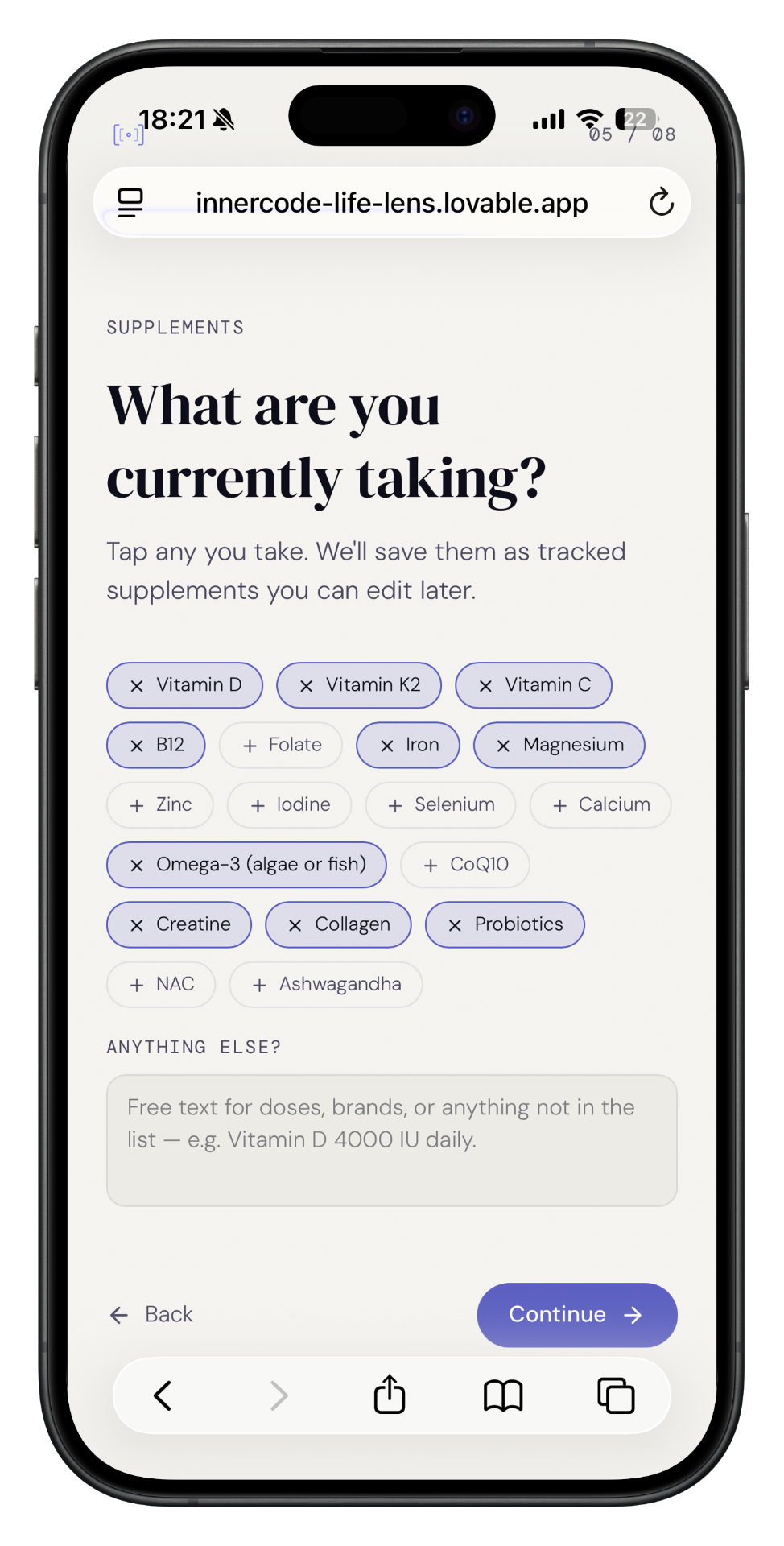
Supplement data is not a profile field. It is an active input to every insight the product generates. Collecting it at onboarding is not optional: it is the minimum condition for a trustworthy result.
INSIGHT 03
Trust is architectural, not cosmetic
Evidence: The participant felt safe uploading real data but still named lingering unease. The consent moment reduced friction without fully resolving the underlying concern.
Trust in health products is built slowly and lost the moment a company's interests diverge from the user's. It cannot be solved with better copy or a reassuring colour palette. It requires structural choices: explicit consent, visible data ownership, and a permanent delete option communicated before the upload.
From insight to question
HMW 01
How might we make blood result interpretation feel built for this specific person, not built around a 30-year-old man, and ensure that the user's age, life stage, diet, and supplement profile shape every insight?
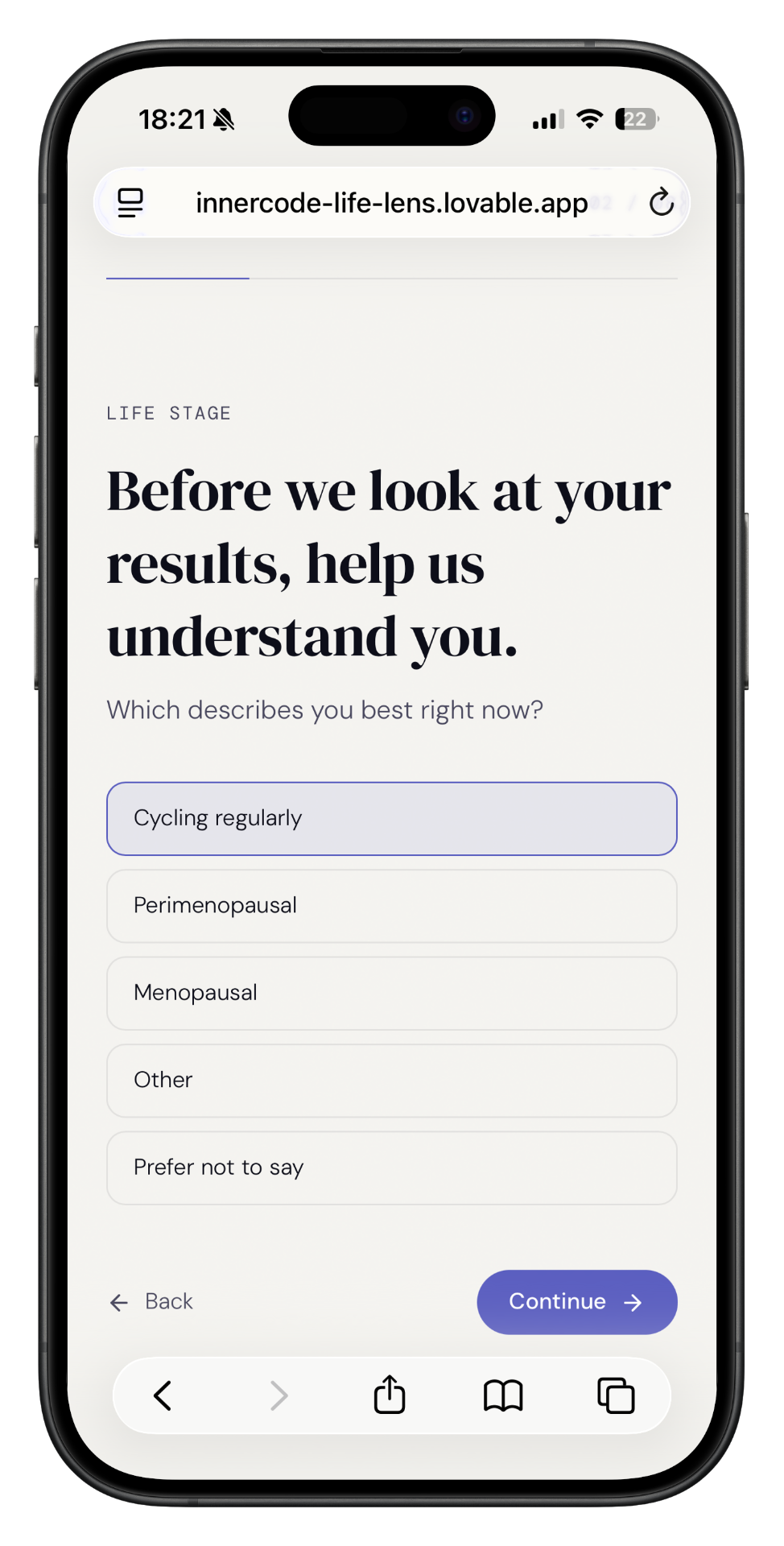
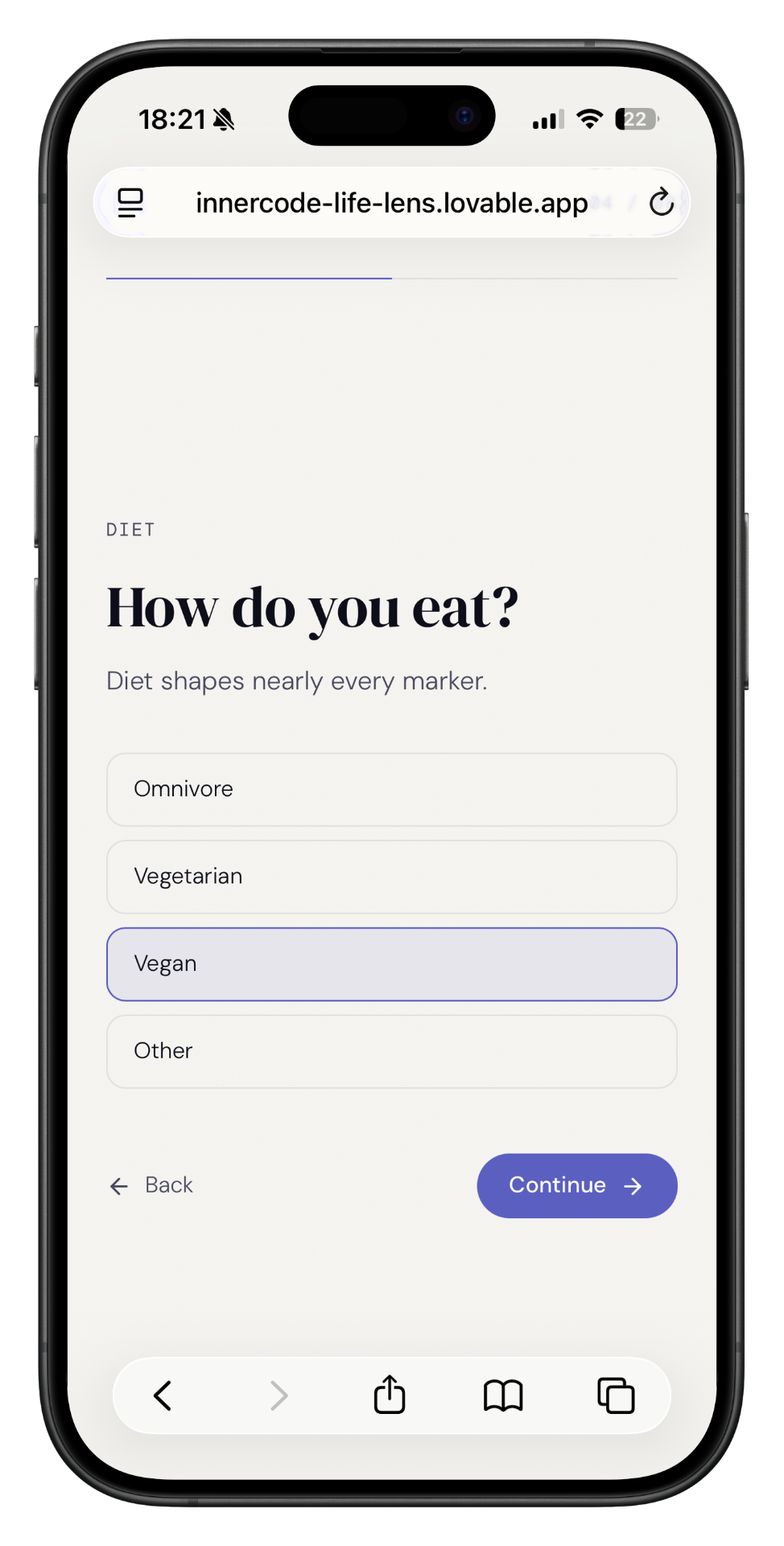
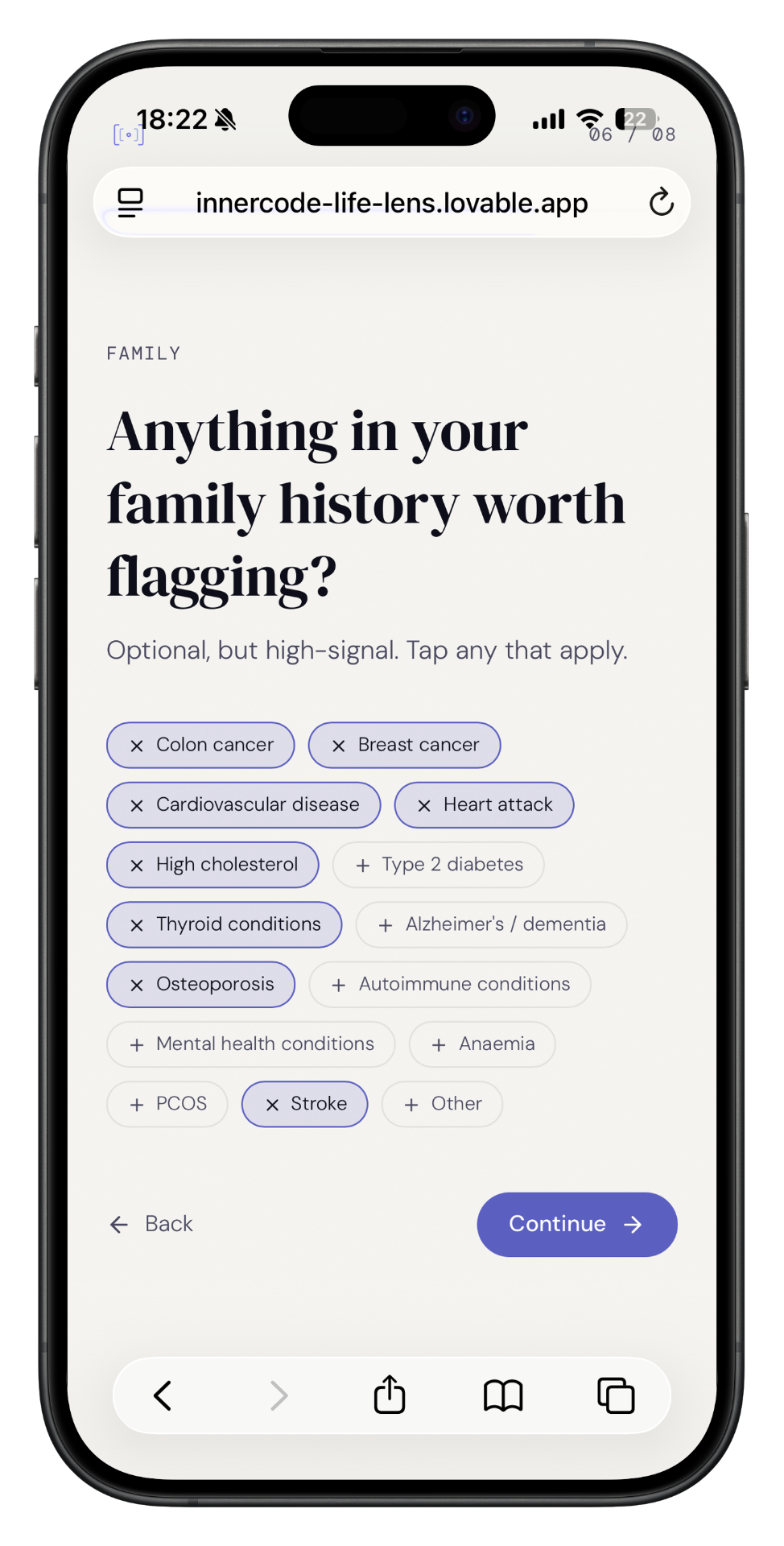
Led to:The four-question onboarding. Life stage, diet, supplements, and family history collected before any result is read.
HMW 02
How might we make the supplement protocol visible and connect it to blood results, for the first time across any health app?
Led to:Supplements collected at onboarding as an active input to the interpretation engine, not stored as a passive profile field.
HMW 03
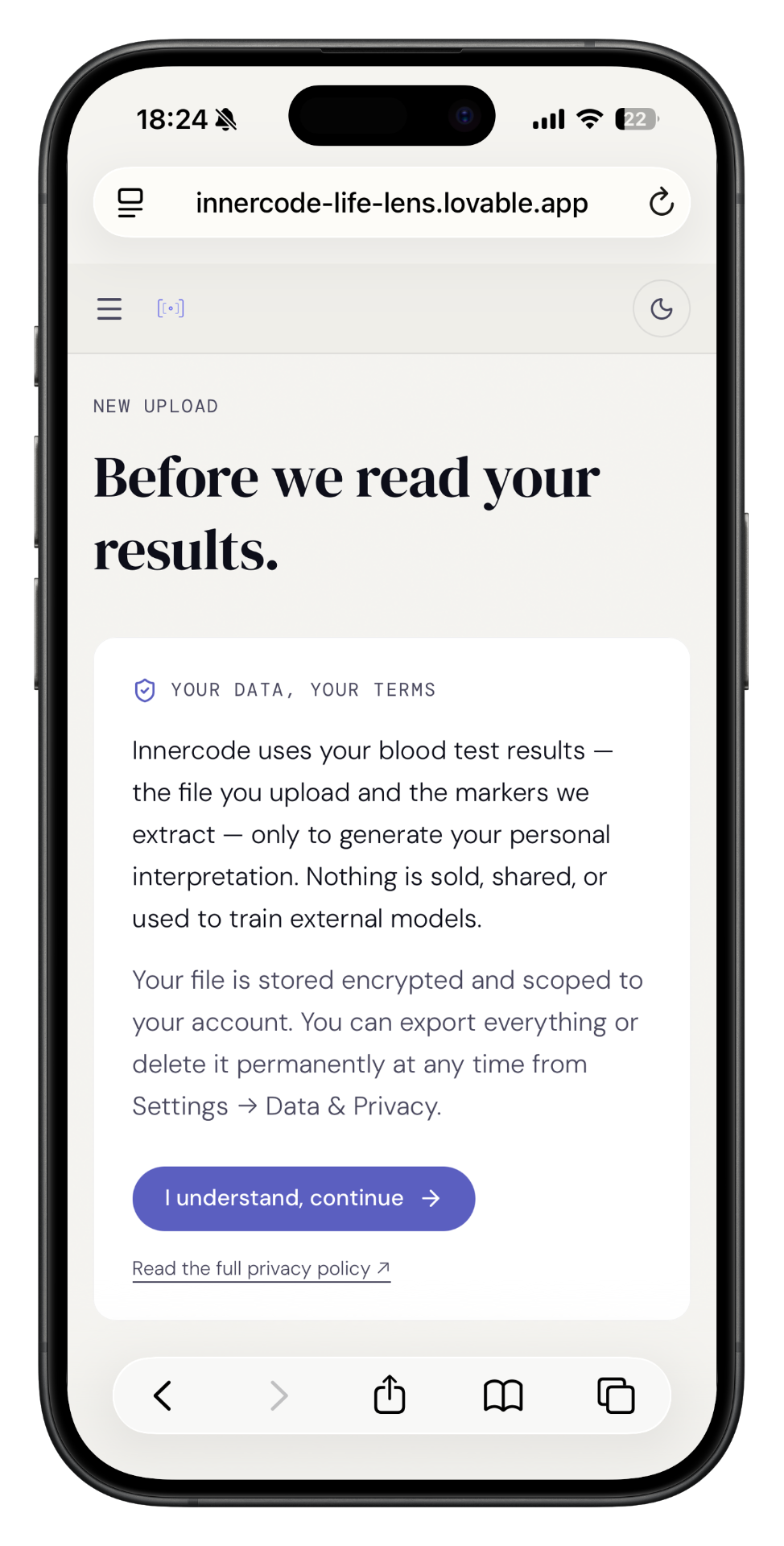
How might we make a user feel genuinely safe uploading sensitive health data, before the upload rather than after?
Led to:A dedicated privacy screen before the upload step. Not a terms checkbox. An explicit moment: what happens to this data, who sees it, and how to delete it permanently.
04 — The Solution
The Results Hub.
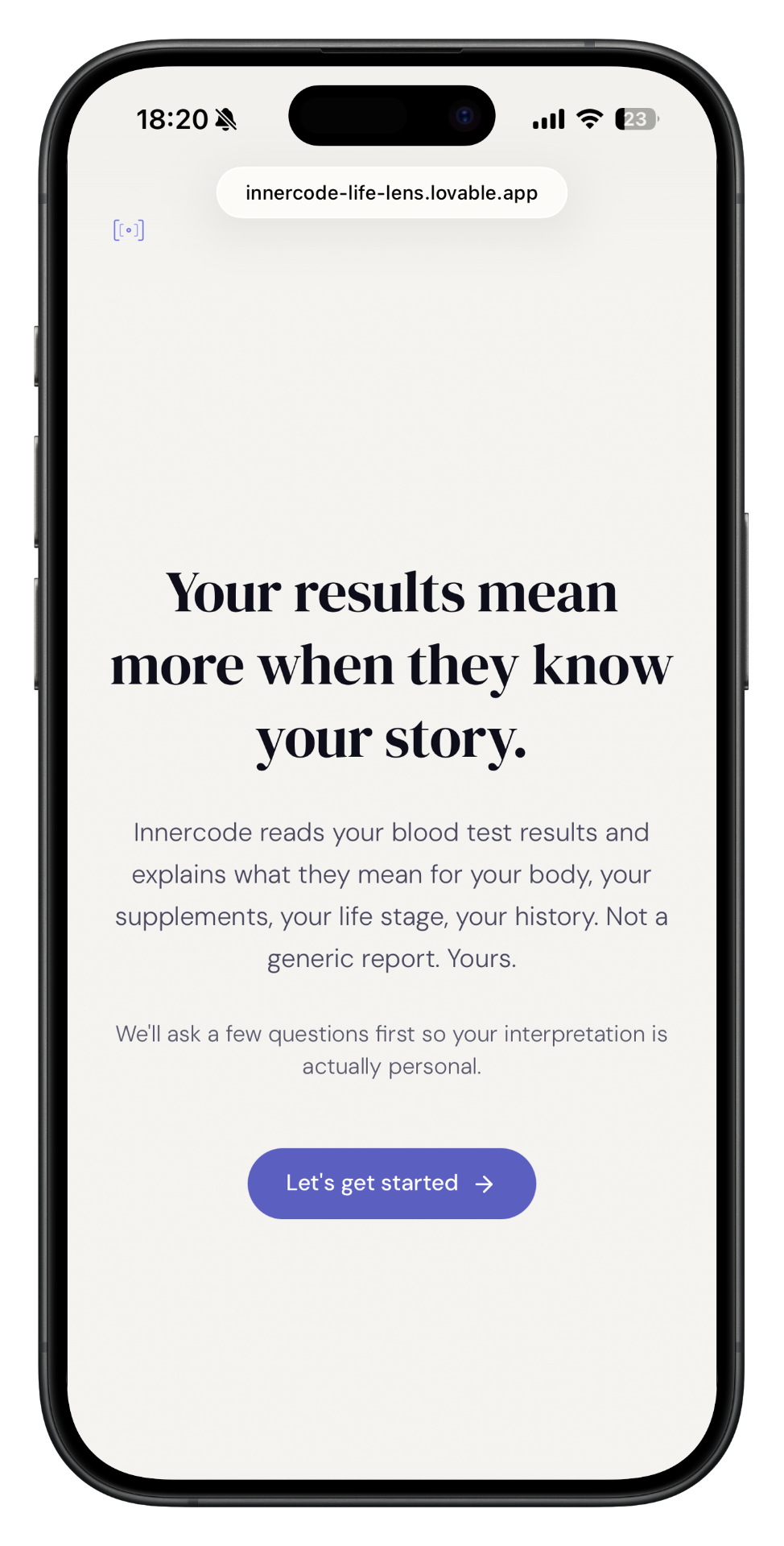
A tool that lets users upload their blood test results and receive personalised, science-backed interpretation—not calibrated to a population average, but to who they actually are.
Before reading your results, we learn who you are.
The onboarding asks four questions that turn a generic blood report into a personal one: life stage, diet, current supplements, and family history. These aren't profile fields, they're active inputs to every insight the product generates.
Product Demo
Trust isn't assumed. It's earned before the upload.
Before any file is uploaded, Innercode shows a plain-language privacy screen—not a checkbox buried in settings, but an explicit moment: what happens to this data, who sees it, and how to delete it permanently. This design decision came directly from research: our users don't have vague privacy anxiety, they have considered positions.
No AI chat before the foundation
A chat interface built on incomplete synthesis is a liability in health. The Results Hub builds the knowledge layer first: synthesis logic, personalization model, source curation. Everything else comes after.
No unsourced information
Every recommendation shows its origin: the research it draws from, the population it was built on, the limitations of that evidence. Users are never asked to simply trust the app.
Data ownership is non-negotiable
Users aren't giving Innercode their data, they're using a service that requires their data to function. Ownership never transfers. Communicated explicitly at upload, not buried in settings.
05 — Outcomes
The interpretation exceeded every expectation.
For the usability test, a participant uploaded her own real blood test results and completed the core flow independently.
"It was the first time I received professional-quality feedback on my results."
First impression
Beautiful, clear, very well organized. Design quality created confidence before she'd even started.
Interpretation quality
More detailed than anything she'd received from a doctor. Used the word ‘impressed’ twice, unprompted.
Doctor-prep loop
Motivated to go to her next appointment with better questions, without being prompted.
Independent action loop
Motivated to take practical health actions on her own, in parallel with seeing her doctor.
Would recommend
‘Yes, I would definitely recommend it to a friend.’—a definite yes, no hedging.
Privacy anxiety
Felt safe enough to upload real data, but noted residual background unease. Worth addressing in the next iteration.
Two action loops activated: the product isn't replacing the doctor, it's making users better-informed patients.
06 — What this is for
She knows. She decides. She acts with purpose.
Innercode wins when the health-aware woman who once dreaded her results now opens them with confidence. Not because she became a medical expert, but because she finally has a tool that speaks to her body, her history, and her life. She is no longer guided by fear or operating on a vibe.
Strengthen the consent and privacy architecture throughout the experience
Make supplement data visible. The single biggest gap in discovery research
Expand beachhead research to validate findings across more participants
Innercode · Product Management Capstone · neuefische · June 2026